Wednesday, August 18, 2010

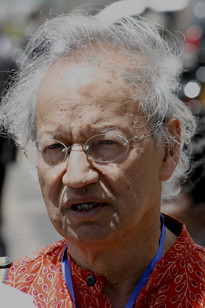
Yash Pal Ghai

Yash Pal Ghai, scholar in constitutional lawYash Pal Ghai born in Nairobi, Kenya (1938) is a scholar in constitutional law. As of 2007 he is the head of the Constitution Advisory Support Unit of the United Nations Development Program in Nepal and a Special Representative of the UN Secretary General in Cambodia on human rights. He has been a Fellow of the British Academy since 2005. In September 2008, he resigned his post in Cambodia, following bitter arguments with the Government of Cambodia.

He was the Sir YK Pao Professor of Public Law at the University of Hong Kong starting in 1989. He has been an Honorary Professor there since his retirement in 1995. Prior to that, Ghai taught and did research in law at the University of Warwick, Uppsala University in Sweden, the International Legal Center in New York, and Yale Law School. He has also taught courses at the University Of Wisconsin Law School, as part of an exchange program. He was the Chairman of the Constitution of Kenya Review Commission (which attempted to write a modern constitution for Kenya) from 2000 to 2004.

Ghai has also advised and assisted NGOs in human rights law related work. He drafted the Asian Human Rights Charter - A People's Charter, a project of the Asian Human Rights Commission.

His grandparents came from North India, being parts of the waves of migration sponsored by the British Empire. His earliest memories of Kenya are about racial discrimination and hatred. His father sent Ghai to Oxford to study.

Ghai has written several books on law in Africa, the Pacific islands, and elsewhere.

Source/ for updates go to: Wikipedia

Tuesday, August 17, 2010

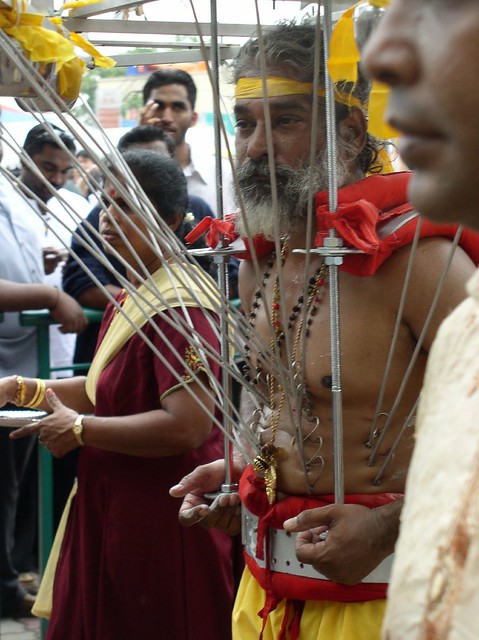
Vel Kavady during Thaipusam festval

Ouch

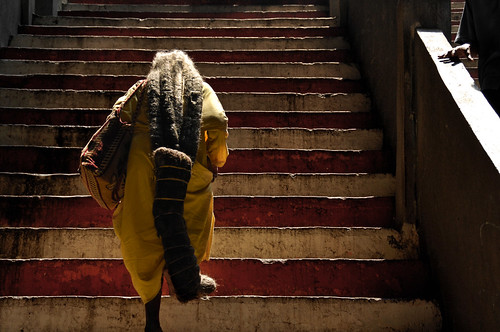
94-year-old woman ascends Batu Caves temple steps

A 94-year-old woman ascends the final stairs in the 272-step ascent in the Batu Caves
Hindu Ascent, originally uploaded by Stuck in Customs.

The note added by the author says 'A 94-year-old woman ascends the final stairs in the 272-step ascent in the Batu Caves, a pilgrimage site in Malaysia... Her hair is 3 meters long (about 9 feet). She has never cut it her entire life. It is so long, she has to fold it back and forth a few times and wrap it to keep it from dragging behind.'

Batu Caves Lord Murugan Temple - video

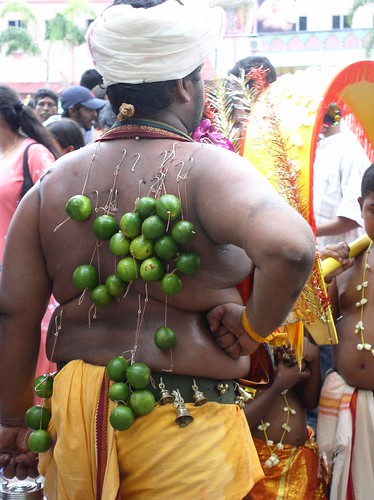
Lord Muruga devotee at Batu Caves

A Lord Muruga devotee at Batu caves shows his bare back where several lemons are hooked on to his skin
P1010171, originally uploaded by tajai.

The photo shows a Lord Muruga devotee at Batu caves, Malaysia, where Thaipusam was celebrated in the temple of Lord Muruga. Watch his bare back where several fruits/vegetables, probably lemons are hung from hooks dug into his body. The Lord Muruga idol here is the tallest Muruga idol in the world.

Sunday, August 15, 2010

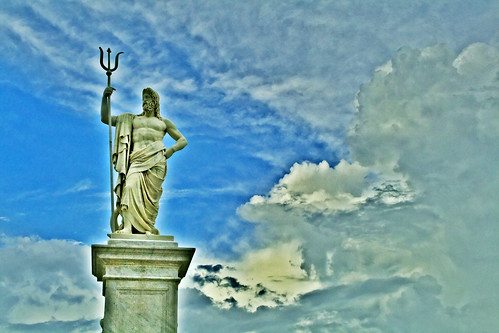
Neptune with a trident

Neptune

Photo: Neptune (God of the Seas, patron god of Atlantis and fishermen) located at Habana in Cuba

Neptune, the god of water and the sea, in Roman mythology, is a brother of Jupiter and Pluto. Often he is described as God of the seas, storms and earthquakes, symbols of destruction, and he is shown holding a trident.

He is described as analogous with but not identical to God Poseidon of Greek mythology, often imaged according to Hellenistic canons in the Roman mosaics of north Africa (The Roman empire at its golden times covered the whole of North African Mediterranean coastal countries and almost the entire Middle East, including Turkey, Egypt and Israel). Often he was paired with Salacia, the Goddess of the salt water.

Wednesday, August 11, 2010

Chili pepper: Bhut Jolokia?

Photo of a heap of red hot chillies, possibly the Bhut Jolokia or Naga Pepper
pep squad, originally uploaded by lilymox.

From the look of these chili peppers, especially the chocolate-colored ones, it seems these are the hottest chilies in the world, the Bhut Jolokia, often called Naga Jolokia (possibly erroneously) or the ghost chili by the Western media.

The chili pepper (aka Nahuatl chilli, chillie, chili, chile, etc.), a fruit of plants from the genus Capsicum, although botanically are berries, peppers are considered vegetables or spices.

In February 2007, Guinness World Records published that the Bhut Jolokia was the hottest chili pepper ever submitted for judgment.

Monday, August 9, 2010

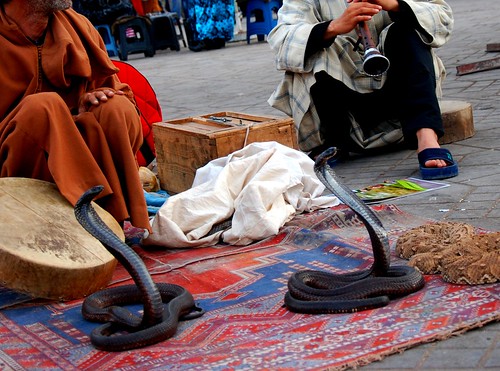
Snake Charmers in Morocco

Snake charming, a typical performance in which snakes are made to sway or dance, is commonly attributed to India, but it has practiced for several centuries in Asian countries such as Pakistan, Bangladesh, Sri Lanka, Thailand and Malaysia, as well as North African countries such as Egypt, Morocco and Tunisia.

Ancient Egypt was home to a kind of snake charming, but the current practice is believed to have originated in India and then spread throughout Southeast Asia, the Middle East and North Africa. The popular species of snakes are the common snakes found locally, though various varieties of cobras are preferred by snake charmers and their audiences.

In India, the Indian cobra is commonly seen with snake charmers, though some charmers may also use Russell's vipers, Indian and Burmese pythons and some other local species of snakes. In African countries such as Egypt, Morocco and Tunisia, Egyptian cobras, puff adders, carpet vipers and horned desert vipers are commonly featured in snake charming performances.

Thursday, August 5, 2010

Kailash Kora: Mount Kailash shining in the morning sun

Mount Kailash (also known as Kailasa Parvata, Kangri Rinpoche, Tise mountain, Gangs Rinpoche, etc.) is a peak in the Gangdise Mountains, a part of the Himalayas in Tibet. The peak is located near Lake Manasarowar and Lake Rakshastal in Tibet.

Some of the longest rivers in Asia such as Indus River, Sutlej River (a tributary of Indus River), Brahmaputra River, and Karnali River (a tributary of Ganges River) all originate in Mount Kailash-Lake Manasarovar region.

Mount Kailash is considered a sacred place for pilgrimage by religions such as Hinduism, Buddhism, Jainism and the Bon faith. Every year, thousands pilgrims travel to Kailash, a pilgrimage tradition going back thousands of years. Pilgrims of many religions believe that circumambulating Mount Kailash on foot is a holy ritual that will bring good fortune. The path around Mount Kailash is 52 km (32 miles) long.

Mount Kailash is located in a particularly remote and inhospitable area of the Tibetan Himalayas. A few modern amenities such as benches, resting places and refreshment kiosks, restaurants etc. exist there for the pilgrims.

According to Hinduism Lord Shiva resides at the summit of the legendary Kailasa, where he meditates along with his wife Goddess Parvati, the daughter of Himalaya.

Tantric Buddhists believe that Mount Kailash is the home of the Buddha Demchok (Demchog or Chakrasamvara) who represents supreme bliss. There are many sacred sites in the region associated with Guru Rinpoche (Padmasambhava) whose Tantric practices in holy sites around Tibet are credited with establishing Buddhism as the main religion of Tibet in the 7th-8th century AD.

The Bon, a religion and the oldest still-extant spiritual tradition which predates Buddhism in Tibet, maintains that the entire mystical region and the nine-story Swastika Mountain are the seat of all spiritual powers.

Following the Chinese army entering Tibet in 1950 and the Sino-Indian War of 1962, pilgrimage to Mount Kailash was stopped from 1954 to 1978. After that, a limited number of Indian pilgrims have been allowed to visit Mount Kailash, under the supervision of the Chinese and Indian governments.