Showing posts with label paintings. Show all posts

Sunday, May 30, 2010

Witchcraft through ages

Picture: Witches (Woodcut, 1508) by Hans Baldung Grien (1480-1545), the famous German Renaissance artist in painting and printmaking in woodcut.

Among the believers of monotheistic religions, sorcery came to be associated with heresy and apostasy, and hence it was viewed as evil. Among leaders of established popular religions and even secular leadership of the late Medieval/ early Modern periods, fear of witchcraft was widespread and sometimes it led to large scale witch hunts. In such hunts, not only practitioners of witchcraft, but even believers of minor religions and sects were also targeted. As a result, in Europe and some parts of the middle east, hundreds of thousands of people suspected of practicing witchcraft were imprisoned, tortured, banished, executed, and the lands and possessions of tens of thousands of accused persons were confiscated.

Interestingly, the majority of the accused witches were women, though in some regions the main focus shifted on men. Mostly, accusations of witchcraft were combined with charges of heresy against groups such as the Cathars and Waldensians. Cathars, or believers of Catharism, were a Christian religious sect with dualistic and gnostic beliefs who lived in the Languedoc region of France and other parts of Europe in the 11th century to 13th century.

The Waldensians (aka Waldenses or Vaudois), a Christian movement of the later Middle Ages and descendants of whom still exist, are active congregations in Europe, South America, and North America, and they are followers of the Waldensian Evangelical Church. Their spiritual heritage is considered lofty, and includes proclaiming the Gospel, serving the marginalized people, promoting social justice, fostering inter-religious services, and advocating respect for religious diversity and freedom of thoughts.

An infamous and widely circulated witch-hunting manual written by Heinrich Kramer, an Inquisitor of the Catholic Church, is ‘Malleus Maleficarum’, first published in Germany in 1487. It instructs governments, law courts and priests about how to identify witches, why most witches are women, how to put witches on trial and how to punish witches. The book also defines a witch as evil and typically as a female. The main purpose of the Malleus was to refute arguments claiming that witchcraft does not exist. Also it promoted the idea that witchcraft do exist in large scale. As a result, anyone found not believing in the mainstream religion was persecuted by others.

Due to invention of mechanical movable type printing press in the fifteenth century by Johannes Gutenberg, the printing and circulation of Malleus Maleficarum dramatically spread throughout Europe rapidly in the late fifteenth century and the early sixteenth century. In the words of Bertrand Russell, "the swift propagation of the witch hysteria by the press was the first evidence that Gutenberg had not liberated man from original sin." The Malleus is also heavily loaded with the subjects of divination, astrology, and healing rituals the Catholic Church inherited from antiquity.

Religious, spiritual and philosophical confusion prevailed all over, as the late fifteenth century was also a period of religious turmoil. The ideas contained in Malleus Maleficarum and the witch craze promoted by it took advantage of the increasing intolerance of the Reformation movement and the Counter Reformation movement in Europe, where the Protestant and Catholic camps, fighting against one another and zealously trying to maintain the purity of their respective faiths.

Even in today’s world, witchcraft accusations are regularly reported, often it is often followed by the satanic ritual abuse and moral panic. Ironically, there seems to be an increase in the followers of witchcraft, and an equally increasing number of people fearing and opposing witch craft. Both are based on superstitions or illogical thinking, sometimes find support from misguided religious, spiritual and political leaders, and lead to blood libel of various kinds. These are not limited to any one region or religion, but can be found across believers of many religious groups all around the globe.

Wicca practitioner Ipsita Roy Chakraverti, who declared herself as India's first trained witch years ago, said in an interview, "Sometimes our darker forces come to the fore and dominate events. These are always there in our subconscious and it is when these forces come out that the unexplainable takes place." In her website (www.wiccanbrigade.com/ipsita/bio.htm) Chakraverti states, “Even though I studied Wicca in the West, I believe at one time it was a global movement. In India, I have researched Dakini Vidya which draws its strength from the Goddesses Kali and Durga. Just as I have wrapped myself in the black cloak of Isis and stood like a queen among my peers, arrogant and beautiful, so also I have walked with bare feet on the cold grey stones of the Yogini Temple in Orissa, India, and felt them warm with a sudden pulsation under my feet. The same Goddess force which goes by the name of Isis, Athena or Minerva in the West, manifests as the Yoginis in the East.” Chakraverti has published her experiences and views in the form of two books, ‘Beloved Witch’ (2000) and ‘Sacred Evil: Encounters with the Unknown’ (2003).

Do you believe in witchcraft?

Painting: ‘Examination of a Witch’ inspired by the Salem Witch Trials, painted by T. H. Matteson, an American painter, known for the use of historical, patriotic and religious themes in his works.

The notorious ‘Salem Witch Trials’ were a series of legal hearings to prosecute people accused of witchcraft in Essex, Suffolk, and Middlesex counties of colonial Massachusetts (now in USA), between February 1692 and May 1693. The episode has been highlighted in political rhetoric, literature and popular culture as a cautionary tale about the dangers of religious extremism, superstitions, false accusations, lapses in due legal process, and even as governmental intrusion on individual liberties.

The ‘Salem Witch Trials' of 1692 were conducted in a many places such as Salem Village, Ipswich, Andover and Salem Town. The most publicized trials were conducted by the Court of Oyer and Terminer in 1692 in Salem Town. Over 150 people were arrested and imprisoned, with many more accused of witchcraft but not pursued by the authorities. Five of the accused died in prison and all twenty-six people who went to trial before this court were convicted.

The four sessions of the Superior Court of Judicature in 1693, held in Salem Village, but also in Ipswich, Boston and Charlestown, produced only three convictions in the 31 witchcraft trials it conducted. The two courts convicted 29 people of the capital felony of witchcraft. 19 of the accused - 14 women and 5 men - were hanged, and a man, Giles Corey, who refused to enter a plea, was crushed to death under heavy stones in an attempt to force him to do so.

Belief in witchcraft, witch hunts and persecutions of alleged witches can be found in many cultures, almost in all countries in one form or the other. While it is reportedly the worst in Sub-Saharan Africa, witch craft practices and opposition to such practices are still rampant in Europe, many Asian countries and in the Americas. In Europe of 14th to 18th centuries, witchcraft was allegedly seen as ‘a vast diabolical conspiracy against Christianity, and accusations of witchcraft led to large-scale witch-hunts, especially in Germanic Europe.’

In 19th and 20th centuries, a controversial theory speculated that European witchcraft was a suppressed pagan religion. Since the middle of the 20th century, witchcraft has become the self-designation of a branch of neo-paganism, especially in the Wicca tradition.

By simple definition, a witch (old English: Wicce/ Wicca) is a practitioner of witchcraft. Witchcraft is the use of supernatural or magical powers; the use of such powers in order to inflict harm or damage upon members of a community or their property. Reference can also be found about good witchcraft practiced to heal someone from bad witchcraft. Witchcraft is often linked to cultural ideologies, as means of explaining human misfortune by blaming it either on a supernatural entity or a known person in the community.

The cause of the symptoms of those who claimed affliction by witchcraft continues to be a subject of scientific interest. Medical and psychological explanations for the reported effects of witchcraft have been explored by researchers, and most conclusions find the cause in normal afflictions not associated with witchcraft. But some modern academics are less inclined to believe that the cause for the behavior was biological, exploring instead motivations of jealousy, spite and a need for attention to explain behavior they contend was simply acting.

Many practitioners of witchcraft are also found to use methods such as magic, sleight of hand, mesmerism/hypnotism/animal magnetism, and even chemicals and drugs etc., and some of them are also reported to pose as spiritual healers, swamis, babas, or spiritual masters because of the hatred people have now developed against witchcraft. There are also hundreds of cases of lynching/killings of witchcraft practitioners in the villages of Indian states of Bihar, West Bengal, etc., with the maximum killings reported from Chhattisgarh.

Tuesday, May 18, 2010

Painting showing Swami Haridas, Emperor Akbar and Tansen

Photo: Jaipur-Kishangarh mixed style Rajasthani painting (1750) depicting Emperor Akbar and Tansen visiting Swami Haridas in Vrindavan

Swami Haridas, the spiritual poet and classical musician credited with a large number of devotional compositions in the Dhrupad style, is the founder of the Haridasi School of mysticism. His work influenced both the classical music and the Bhakti movements of North India, especially those devoted to Krishna's consort Radha. He is counted as a follower of the Nimbarka Sampradaya, the Vaishnava tradition of devotion to Radha-Krishna. He was the disciple of Purandara Dasa and the teacher of Tansen.

Saturday, March 13, 2010

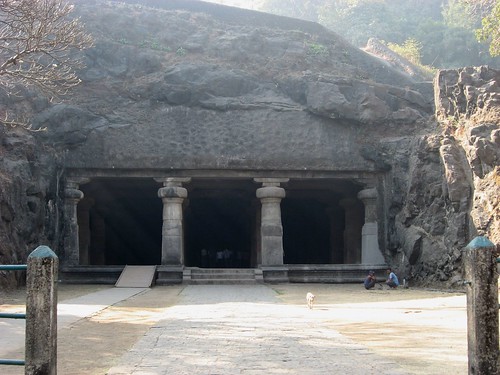
Elephanta Caves, Mumbai

Elephanta Caves front view
Elephanta Caves, originally uploaded by Himanshu Sarpotdar.

The Elephanta Caves are located on Elephanta Island in Mumbai Harbour, about 10 kilometres to the east of Mumbai, India. The island, on an inlet of the Arabian Sea, has a large group of five Hindu caves and a smaller group of two Buddhist caves. The caves are a UNESCO World Heritage Site since 1987, and maintained by the Archaeological Survey of India (ASI).

Ajanta Caves, World Heritage Site

Photo published under Creative Commons Attribution 2.5 Generic license.

Ajanta Caves, in Maharashtra, India, contain ancient paintings and sculptures of both Buddhist religious art and sculpture.

Cave No. 1 is the first cave, with one of the most elaborate sculptures showing scenes from the life of the Buddha. The cave has a front-court with cells, and a porch, once covered with murals of which many fragments remain now. Each wall of the hall inside is nearly 40 feet (12 m) long and 20 feet (6.1 m) high. There is a shrine on the rear wall to house a seated image of the Buddha. There are four cells on each of the left, rear and the right walls. The walls are covered with paintings, fairly well preserved.

The nearby Cave No. 2 is famous for paintings on its walls, ceilings, and pillars. It has a porch quite different from Cave one. The cave is supported by pillars. The size and ground plan have many things in common with the first cave. The front porch consists of cells.

The caves at Ajanta were abandoned by AD 480 and for the next 1300 years the jungle grew back and the caves were hidden, and unvisited until the spring of 1819 when a British officer in the Madras army entered the steep gorge on the trail of a tiger. Within the tangled undergrowth, he came across the almost hidden entrance to one of the caves. Exploring that first cave, long since inhabited by birds, bats and larger animals, Captain Smith wrote his name in pencil on one of the walls, still faintly visible, it records his name and the date, April 1819.