Tuesday, November 15, 2016

Demonetisation hit hawala and fake currency the most

Queue at Bank to Exchange INR 500 and 1000 Notes - Salt Lake City - Kolkata 2016-11-10 02103

People standing in queue outside a private bank to deposit and exchange Rs 500 and Rs 1000 currency notes at Salt Lake City, Kolkata, West Bengal, India.

Following the demonetisation drive by the government, a lot of people who have accumulated Rs 500 and Rs 1000 notes have panicked and acted in bizarre ways. Some others destroyed/burned money that they thought could not be used. Several real estate dealers, transport operators, wholesale traders and others who used to do business in cash only adapted strange ways to convert their defunct bank notes to legal tender. Here are some of the instances that I could read today.

A 60-year-old woman named Mariyumma Muhammed, a native of Kotukkara near Kondotty in Kerala’s Malappuram district, went on Saturday to the SBI branch at Kondotty with 49 currency notes of Rs 1000 denomination (Rs 49000). Finding 37 of the notes counterfeit (Rs 37,000), the SBI officials informed the police who arrested and later remanded her to judicial custody. On questioning, she said her sons working in the Gulf sent the money through Hawala channels. The money was meant for construction of a house.

According to various reports the counterfeit currency notes seized from various places in Kerala in the last few years were printed outside India. Continued and intensive checking and seizure of fake currency by the authorities only forced the operators to change their modus operandi to transport and use Indian Fake Currency Notes (FICN).

According to reports, FICN operators have widespread networks in Kerala and Karnataka and receive over Rs 50,000 crore through Hawala. Almost all the money meant for funding terrorism and other antinational activities enters India through this route.

In another case after the demonetisation drive, Sumit Kumar Tudu of Kendrapara district in Odisha was arrested by Odisha police. He went to deposit Rs 2.5 lakh in the SBI branch at Khurda town near Bhubaneswar. The bank officials found 42 fake notes of Rs 1,000 and 10 fake notes of Rs 500 totaling Rs 47,000. Deba Prasad Kanhar, the in-charge of SBI Khurda, said that they informed the police. Sumit Kumar Tudu claimed that he is the son of a bank officer and his father asked him to deposit the money in his father’s account.

In another sad case, a 48-year old man named Unni, a Kerala State Electricity Board (KSEB) employee, who came to deposit Rs 500,000 worth banned high denomination notes in the State Bank of Travancore in Thalassery, fell to his death from the second floor of the building.

Interestingly, within days of introduction of the new Rs. 2,000 note, Ashok, an onion grower in Chikkamagaluru in Karnataka, was cheated by a stranger with a photocopy of the note on Saturday morning, which he came to know only when his friends told him later.

The new 500 and 2,000 rupee notes are considered "high security" notes having several new security features and cannot be easily counterfeited compared to the now invalid notes.

As a result of demonetization, the Hawala racketeers in Mumbai have taken the worst hit and no transaction is likely to take place in the near future. Business circles in Mumbai fear it will pull down businesses that are accused of heavily depended on such illegal money.

Banks in the country received 3 trillion rupees ($44.4 billion) in the in the first four days after the government’s move to ban high denomination notes on November 8, the Finance Ministry said on Sunday.

The Reserve Bank of India (RBI) on Sunday directed all banks to submit daily reports of cash withdrawals across the counter and through ATMs in order to compile accurate data of currency circulation.

That finally comes to drying up of all the resources of fake currency notes and money in the illegal money transfer circuit, at least for now. Also, a lot of money that avoided the banking route will now get deposited and there will be a huge churning in the entire Indian economy. Of course, there are difficulties being faced by the common people, but I think it help in the long run.

Monday, November 14, 2016

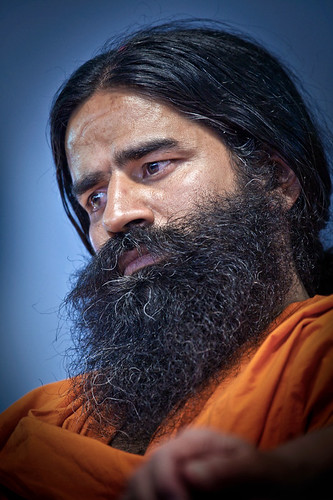
Baba Ramdev and demonetisation of high value currency notes

On June 6, 2011, I wrote an article for this blog on Yoga Guru Baba Ramdev after I read the news of his eviction by the government from Delhi’s Ramlila Grounds. He, along with his followers, was protesting against black money then.

Now again he caught my attention when he told a news agency, “During war, our soldiers fight sans eating for 7-8 days; so can’t we do the same for our nation?”

In the report by the agency it is also brought out that in 2012 Ramdev asked the then Congress-led government to discontinue the Rs 500, Rs 1000 notes.

Now that his wish has been fulfilled by the Narendra Modi government he must be very happy. So, he is busy batting for the demonetisation announced by Modi, and therefore defending the move as vigorously as a ruling party politician, though he is not one.

It is not only long queues outside ATMs and banks, there were reported deaths and also injuries to people as well some people getting angered and breaking glass windows and other properties of banks too. These could have been avoided with a little more right information being given to people just after the announcement of banning the Rs 500 and Rs 1000 notes, or at least when people rushed to the banks for exchanging notes or for depositing the notes in their accounts. It could have been by displaying the correct information at a few prominent spots in front of banks or distributing a few handbills containing the required information.

What happened was that most of the people who rushed to the banks and ATMs had only half-baked information or the wrong information that almost made them believe that all their hard-earned money is banned or otherwise lost because of the government action.

Here are a few incidents that I heard from various people and some tidbits that I read from newspapers:

In Delhi, a lot of people reportedly wasted their money by exchanging a Rs 500 note just for a short distance auto-rickshaw ride worth Rs 30, giving away the note just for buying a soap cake, or such small items.

Some devout and god-fearing persons found the donation boxes before temples as the repository of banned banknotes as they believed that donating the notes to the God will at least get them salvation – or they wanted to cheat the god too? A newspaper carried the photo of some pundits of a temple in Noida, UP, sitting with a huge pile of cash in order to count and stack them.

Another report in the newspapers said that some enterprising traders opened separate counters in their shops to exchange the notes at discounts ranging from 40 to 50 percent.

Those who had a little more to exchange scrambled to jewellery shops to buy gold. The gold traders too made hay as they raised the price of gold from Rs 40,000 to Rs 50,000 per 10 grams against the prevailing rate just around Rs 31,000. The jewelers sold out their stocks within no time and downed their shutters.

Some of the super intelligent and over smart persons searched for beggars in Delhi’s streets and told them to exchange their small change for the bigger denomination notes.

I personally heard a few people in my neighbourhood cursing the banks, the government and whoever they thought were responsible for the imagined loss of their hard earned money.

All these people seriously believed that they were carrying not banknotes of any value but just pieces of paper. Apart from whatever half-baked information they had, the shop keepers and whoever they talked to, just told them that the notes are banned and they are worth nothing.

The above anecdotes simply tell you that all the chaos, the serpentine queues, etc. were just because of misinformation.

Here are a few more things reported by the newspapers.

A 55-year-old woman named Vinoda who had recently sold 12 acres of land for Rs 54 lakh committed suicide in Mahabubabad district in Telangana on Thursday. Her family had spent Rs 4 lakh and had Rs 50 lakh left in cash. After hearing about the demonetisation she believed that notes were worthless and lost everything.

A nursing home in Govandi allegedly refused to treat a baby as a carpenter Jagadish Sharma, father of the newborn, could not pay Rs 6,000 in notes of Rs 100, though he requested to give him time to exchange the notes. The baby and mother were taken to another hospital where the infant’s condition worsened and he died before getting treatment.

There are several other similar cases reported from all over India.

I started with a reference to Baba Ramdev. Though I am not a follower of the Yoga Guru, I follow all the news about him and now I take special interest in reading news about his Patanjali Ayurved that has given a run for their money to multinational companies and top brands in personal care products and daily use items.

Along with the large number of his followers the Baba can help to educate the people at such critical times as I quoted above. What is needed is just passing on the right information at the right time. Alternatively, with the clout he has with some of the national leaders, he can persuade them to take care of such aspects.

Sunday, November 13, 2016

Demonetisation of banknotes in India: some political reactions

Queue at ATM for INR 100 Notes - Howrah 2016-11-08 1773

Queue at an ATM for money in Howrah, West Bengal, on 8 November 2016

Since Indian Prime Minister Narendra Modi declared Rs 500 and Rs 1,000 notes invalid on Tuesday in a sudden and unexpected move for demonetisation of high value banknotes and replacing them with newly printed notes of denominations Rs 500 and Rs 2,000, he has got a mixed bag of reactions. Some are hailing the move while some others are severely criticizing it. How some of the politicians reacted to the move are below.

Indian National Congress criticised the central government's move to ban Rs 500 and Rs 1,000 notes. Congress Vice President Rahul Gandhi said that it shows how little Narendra Modi cares about ordinary people. On November 11 Gandhi stood in queue outside the State Bank of India on Parliament Street in New Delhi to experience the ‘pain of the people’. He talked to some people to know their troubles. He said to news reporters who interviewed him, “Poor people are in trouble, I am here to get Rs 4, 000 exchanged. Neither you (the reporters) nor your crorepati owners nor the Prime Minister will understand the problems faced by people.”

Punjab Pradesh Congress Committee (PPCC) president Captain Amarinder Singh on Wednesday criticised the manner in which the government handled demonetisation. Singh said, “Though the move was a step in the right direction in order to curb corruption, terror funding and black marketing, the way it had been handled had led to chaos, with the small farmers, traders, daily wagers and the poor the worst hit.”

West Bengal Chief Minister and the chief of Trinamool Congress Mamata Banerjee tweeted, "I want to know from the PM how my poorest brothers, sisters who've received their week's hard earned wage in one Rs 500 note will buy atta, chawal, tomorrow?" She told the press in Kolkata on Saturday that despite ideological differences she is ready to work with CPI (M), Congress, Samajwadi Party, and Bahujan Samaj Party ‘to save the country’.

Delhi Chief Minister Arvind Kejriwal (AAP) alleged, "Demonetisation is a big scam... People close to BJP were alerted in advance. There were heavy deposits in banks in July-September quarter. Who deposited these thousands of crores suddenly?"

Mulayam Singh Yadav, the chief of Samajwadi Party (SP) that rules Uttar Pradesh, said on Thursday at a press conference in Lucknow, “The sudden ban on high denomination notes has caused immense hardships to commoners, farmers and the poor, the demonetisation has been done by the NDA government with an eye on elections, and not keeping plight of people in mind.” He further said, “We are against black money. SP has fought against it. We do not want use of black money in elections.” He demanded a rollback of the ban ‘for a few days in view of the wedding season’.

Uttar Pradesh Chief Minister Akhilesh Yadav (SP) asked the government to ‘take all possible steps to minimise inconvenience to common people’, adding, "Central government must set up special banking counters in villages and district centres to assist the public, villagers and farmers."

Bahujan Samaj Party (BSP) chief Mayawati told reporters in Lucknow, “Economic emergency like situations have been created by the government to hide their inefficiency. Poor people, middle class citizens, small businesses and farmers have been hit the most and not the people who have black money.”

The Communist Party of India (Marxist), CPI (M), on Wednesday alleged that the move will burden ordinary people and increase bureaucratic harassment of people. Sitaram Yechury, the CPI (M) General Secretary, described it as ‘poorly planned’. He tweeted, "To uncover the illicit money trail, we demand that the govt release the name of Top 100 defaulters of bank loans". "This demonetisation is attempted as a gimmick to divert attention from serious social and political failures of this govt in past 2.5 years."

Pinarayi Vijayan, Chief Minister of Kerala - ruled by the CPI (M)-led Left Democratic Front (LDF) - criticized the demonetisation saying, “It has to be understood that those who are having black money were aware of this earlier and hence they have not been affected with this. It has only affected the common man the most. The Centre has implemented this without looking into the practical difficulties face by the people." He wanted time till December 31 for people to use the existing notes.

Goa Chief Minister Laxmikant Parsekar (BJP) told reporters on Wednesday the demonetisation would not affect tourists who had arrived in the state. He said, “Like other people, the tourists can convert up to Rs 4,000, and usually they avail the facilities using credit cards. The inconvenience will be only for a day. From day after tomorrow, they can withdraw from ATMs”. He said he was personally happy with the ban which was to curb corruption, black money and terrorism. “There are some politicians who have stashed black money in their go downs. They are now having the sleepless nights,” he said, further adding that the clampdown on black money will also ensure that there is a ‘cleaner pre-election period’”.

Andhra Pradesh Chief Minister and the Telugu Desam Party (TDP) chief N Chandrababu Naidu described it as bold step. However, he suggested that reintroduction of high denomination notes should be revisited and urged the government to look for alternatives.

Swaraj Abhiyan leader Yogendra Yadav tweeted, "Positive move against counterfeit currency. Govt overplaying impact on black money. Opposition overplaying transitional problems."

It appears that demonetisation was initially welcomed by the people and political parties in India, with a few exceptions. But it is usually alleged that black money is used by politicians to influence voters during elections. State Assembly elections are going to be held in UP, Punjab, Goa, Uttarakhand and Manipur early next year. So, experts see a political angle in the move. However, the negative reaction to the government’s order, claiming to curb black money and counterfeit banknotes, is not as much as it should be for such a drastic move.

As a result of demonetisation, most people ran short of cash, and there was no way to exchange the higher value notes. Neighbourhood shop keepers and other traders refused to accept the banned notes. Banks were closed immediately after the currency ban to replenish their old currency stocks with the newly printed series of 500 and 2000 rupee notes.

According to political analysts, its impact is expected to show up in the assembly election outcomes in the five states of Punjab, Goa, Uttarakhand, Uttar Pradesh, and Manipur to be held early next year.

Wednesday, February 8, 2012

Meghwals, the pre-Aryan settlers of India

The Megh (also called Meghwal or Meghwar) people are an ethnic community who claim to be of pre-Aryan origins, and who currently live mainly in northwestern parts of India and a small population live in Pakistan. As of 2008, their total population was estimated to be about 2,807,000.

In India, though they live predominantly in Rajasthan, they are also present in the Indian States of Gujarat, Maharashtra, Punjab, Jammu and Kashmir, Himachal Pradesh, Uttar Pradesh, and Haryana.

In some regions, the Meghwal people are also known by names such as Balai, Bhagat, Bhuiyar, Ganeshia, Julaha, Kabirpanthi, Koli, Kori, Meghvanshi, Mihagh, Rakhesar, Rakhia, Rikhia, and Rishia.

The Megh are believed to be people of pre-Aryan origins and belonged to the Indus Valley Civilization. They came to the region from Assyria, the Semitic Akkadian kingdom (2500-608 BC) in the Upper Tigris river region in northern Mesopotamia (present day northern Iraq) and settled in the Sapta Sindhu, literally the land of seven rivers, often identified as the Indus river along with its five major tributaries, the mythological river Sarasvati, and the river identified as the Kubha. When the Aryans invaded the region, the Meghwal migrated to the Vindhyachal and areas of the present day Maharashtra during the Megalithic period (1400-1200 BCE), and later some of them migrated to Bihar and Orissa (Odisha).

They claim that they are the descendants of Rishi Megh. In the traditional folklores, they are also linked to the Suryavansh to which Lord Ram belonged.

Another version of their origin is associated with the Indian mythology according to which Rajarishi Vritra, the ruler of the Sapta Sindhu region, and who founded the Nagavansha dynasty which ruled over the entire India. They also trace their origin to the Hindu mythological characters such as Hiranyakasipu, Prahlada, Hiranyaksha, Mahabali, Banasura, etc.

They have been originally the worshipers of Lord Shiva and Naga (the Snake God). They also worship King Mahabali who ruled Kerala and in whose honor the people from Kerala celebrate the Onam festival. They also were followers of the atheist egalitarian saint Rishi Carvaka.

Some Meghwals of the present times follow the teachings of the Sant Mat, founded by the mystic poet Saint Kabir (1440-1518), based on the supremacy of an inner, loving devotion to a supreme divine power.

The traditional occupation of this ethnic group was mainly agriculture, weaving and woodcarving. In modern times, some of the educated people of the community are employed in government jobs and other white collar jobs, while some others work in factories. Some of them also run their own businesses and industrial units. The Megh women are famous for their mastery of the traditional embroidery and Ralli-making work. They are also master-weavers of wool and cotton fabrics.

Most of the Meghwals are followers of the Hindu religion, though they mainly worship Rishi Megh, Kabir, Ram Devji and Bankar Mataji as their principal gods. Their rituals are more or less similar to the ritual practices of the Brahmins.

According to some sources, in the 13th century AD many of these people became followers of the Nizari sect of Shia Islam, and some others became followers of Christianity.

Women are considered of low status in traditional Meghwal communities. Their marriages are arranged by their families before puberty, and after marriage, they move to their husbands’ families. Divorce is generally allowed, and maintenance or compensation is paid to the divorced woman. The custody and upbringing of the children of the divorced couples are the responsibility of the husbands.

Meghs enforce excommunication of persons who break the community traditions. This practice, allegedly, mostly affects their women, who are increasingly subjected to social discrimination on various grounds.

The Megh women in Rajasthan are famous for their intricately embroidered costumes and jewelry. Their costumes are distinguishable by the exquisite use of a primary red pigment extracted from crushed insects.

Exotic hand-embroidered costumes are essential part of the dowry of the Meghwal women. Married women usually wear gold earrings, nose rings and necklaces and other neckpieces made of silver or gold. The ornaments are mostly embedded with precious stones such as ruby, emerald, sapphire and other precious gems.

Sunday, January 1, 2012

Wish You Happy New Year 2012!

Wish all of you, your families and friends a great New Year 2012, full of happiness, good health and prosperity!

Here is a video of Sydney Harbor New Year celebrations fireworks. Hope you enjoy it!

Krishna

Tuesday, October 11, 2011

Jagjit Singh’s death marks the end of an era

Jagjit Singh by Heritage Arts & Events
Jagjit Singh, a photo by Heritage Arts & Events on Flickr.

Jagjit Singh, considered one of the most popular Ghazal singers of all times, passed away on 10 October 2011 at the age of 70 in Mumbai’s Lilavati hospital. He was suffering from brain hemorrhage.

Though Singh underwent an emergency surgery to remove clots in his brain, he was breathing with the aid of a ventilator and his condition was critical. He was hospitalized in October 2007, following blood circulation problems.

Almost until the last days of his death, he loved to sing on stage and just before being hospitalized, on 20 September 2011 he performed in his last concert held at The Indian Public School, Dehradun, and on 16 September 2011, he performed at the Nehru Science Centre, Mumbai.

Singh’s music knew no borders. He was not only very popular in India, but also in Pakistan, Afghanistan, and many other Asian countries and all over the world where there was the presence of Indian Diaspora, Indian culture and even Asian influences.

Monday, October 10, 2011

Vasuki Sunkavalli at Miss Universe 2011

Vasuki Sunkavalli, Miss India 2011 (height: 5'8.5”, Vital Stats: 30”- 25.5”-36.5”), poses in swimwear on arrival in São Paulo, Brazil, competing for the Miss Universe title in August/ September 2011 – photo by Bruce Casanova Photography©

Vasuki was born in Secunderabad, India, on 17 August 1984 in a Hindu family, originally from Unguturu village in West Godavari district of Andhra Pradesh. Her father, Venkat Ramana Sunkavalli, is in real estate business and her mother, Surya Prabha, runs her own boutique in Hyderabad, India.

Vasuki had her schooling at St. Ann's High School, Secunderabad, and later she joined Villa Marie Degree College in Hyderabad. In 2002, she joined the Symbiosis International University in Pune, India, for studying law and obtained her degree (LL.B). In 2007, she moved to New Delhi to pursue a Diploma course in Intellectual Property Rights from Global Institute of Intellectual Property. In 2009, she was granted the Dean’s Scholarship to study International Law and Human Rights and enrolled for it at the New York University School of Law (NYU Law) from where she graduated with a Master of Law (LL.M).

In 2007, Vasuki started her modeling career by walking the ramp at Wills India Fashion Week, and later she participated in various fashion shows for top fashion designers from India and modeled for several popular brands including Kitkat, Nike, World Gold Council, etc.

On 15 July 2011, Vasuki competed against 19 other contestants from India, and won the crown and title ‘I Am She - Miss Universe India 2011’, a national beauty pageant (organized by Tantra Entertainment Private Limited and former Miss Universe and Bollywood actress Sushmita Sen), which is authorized to send participants to the Miss Universe pageants, after Femina Miss India relinquished its patent in 2010 to send India’s representative to the event.

However, Vasuki failed to make it even to the final 16 at the Miss Universe 2011 pageant in São Paulo, Brazil, possibly because, she could not pose in her national costume which was not delivered to her in time.

It may be noted that the last time India won the crown was in 2000 when Lara Dutta, now a popular actress, had won the Miss Universe crown for India.

Monday, June 6, 2011

The aftermath of the midnight crackdown on Baba Ramdev

Baba Ramdev by Darko Sikman Photography
Baba Ramdev, a photo by Darko Sikman Photography on Flickr.

It seems the Indian democracy is undergoing a process of self-examination.

According to reports, about 60 supporters of Baba Ramdev were injured while the police was trying to evict the Baba and his supporters from the Ramlila ground where he was to launch a hunger-strike against corruption and black money, with his emphatic requirement that the Central Government must take appropriate steps to repatriate black money stashed away in foreign accounts.

There were dialogues going on between him and the government on this issue, and by last Saturday it seemed that there was agreement between the two sides on the issue. The next report was that the Baba was evicted from his protest venue in New Delhi and flown to the nearby airport to his Ashram and from there taken by road to his Ashram.

The media, print as well as electronic, got busy in running ‘BREAKING NEWS’ and conducting reviews and interviews on the questions involved. Most of the political parties and NGOs were of the opinion that the government has infringed upon the democratic rights of the Baba and his followers. It is rightly so, because nothing undemocratic was being conducted at the venue.

The reactions after the incident included politically motivated mudslinging, and the sane voices were feeble.

Now that The National Human Rights Commission has issued notices to the Central Government and the Delhi Government directing them to submit their reports on the crackdown on Baba Ramdev and his supporters, the issue gets more serious as the commission has taken notice of something of the nature of human rights violation.

Additionally, there are reports that The Supreme Court of India has also issued a notice to the government on the eviction of the Baba from the hunger-strike venue, after taking suo moto cognizance of the incident on its own.

The government may have its own reasons for its actions, but a majority of others, including those who oppose Baba Ramdev, feel that democratic rights should not be suppressed.

I am not a supporter of the Baba, or any other faction. But I do feel that corruption and black money are the biggest enemies of all the right-thinking Indians. So, it has to be wiped out from all levels of governance and public life, when only India can be said to be a true democracy.